The Flag at Holiday Harbor Was Never About the Water
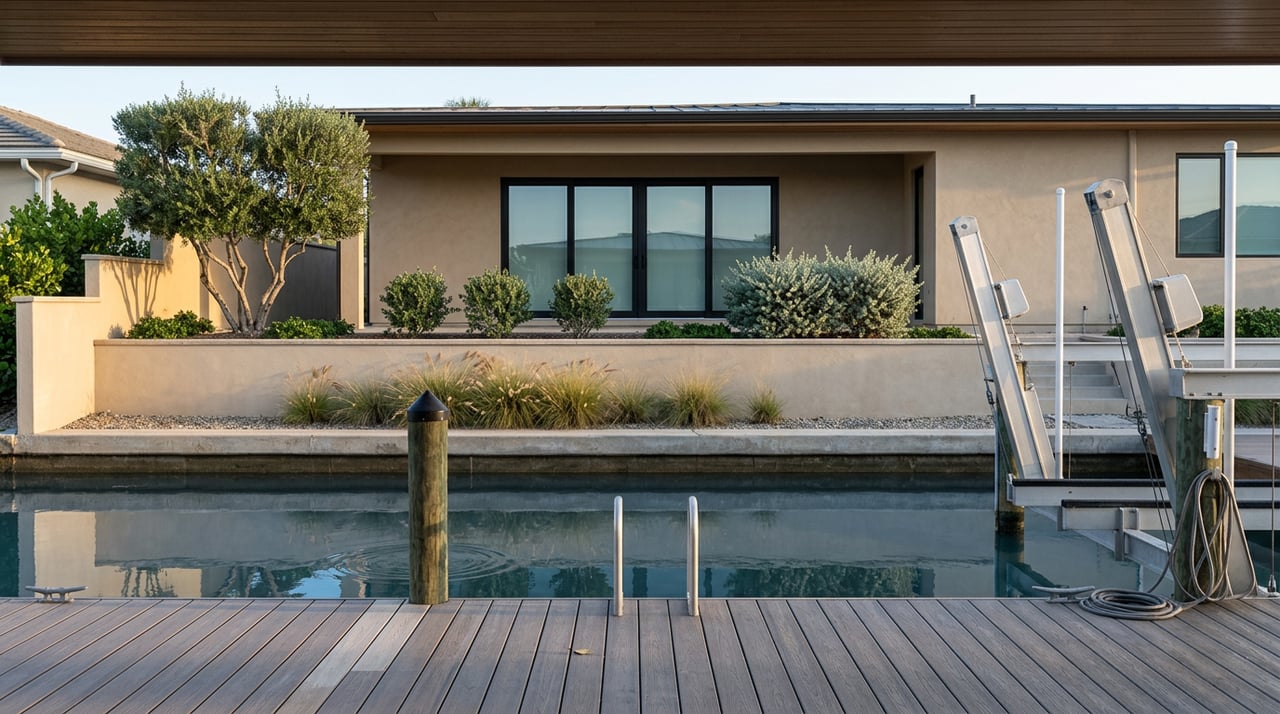
On a Saturday morning in August, a Canyon Lake homeowner walks down to the dock, glances at the flagpole outside Holiday Harbor, sees green, and loads the kids into the boat. Two coves over, a water quality technician working for the Elsinore Valley Municipal Water District is pulling a sample from the East Bay, the same water the family just launched into. Neither one is doing anything wrong. They are just answering two completely different questions, and only one of those questions has anything to do with a flag.
That split is the thing most people who live here have never quite put together. The flag system that governs boating on Canyon Lake and the water quality monitoring that tracks golden algae are run by different organizations, for different reasons, and they almost never talk to each other in a way a boater on the water would notice. If you have ever assumed a green flag meant the water had been checked, it is worth understanding why that assumption is wrong, and why the actual answer says something interesting about what kind of lake this still legally is.
Canyon Lake Property Owners Association posts three flags, at Holiday Harbor and at the Eastport launch ramp, and the meaning is simple: green means no restrictions, yellow means no-wake on the Main Lake, red means the Main Lake is closed to boat traffic entirely. That is the whole system.
| Flag | What it restricts | What it does not measure |
|---|---|---|
| Green | Nothing, normal boating rules apply | Water quality |
| Yellow | No-wake speed on the Main Lake | Water quality |
| Red | All boat traffic on the Main Lake | Water quality |
The trigger for a flag change is almost always weather, not chemistry. The POA is explicit that green flag status often shifts during or after heavy rainfall, specifically to reduce wake damage to the backyards and docks that flood when the lake runs over full. It is a property protection tool. Pair that with the rest of the lake's traffic code, the counter-clockwise ski pattern, the requirement that an observer twelve or older hold a flag while watching a skier, the 35 mph limit inside the Main Lake Ski Area against a 5 mph no-wake rule everywhere else including the entire East Bay, and the picture is consistent. This is a system built to keep roughly 500 acres of private water usable by everyone at once without anyone's dock taking a beating. It was never designed to tell you what is growing in the water.
The reason those two systems live in separate lanes traces back to what Canyon Lake actually is on paper. Railroad Canyon Dam was completed in 1929 to provide irrigation and water storage for the region, not recreation. For its first couple of decades the water level swung with the season's rain, which is a fine setup for a reservoir and a miserable one for anyone trying to keep a dock in the water. That changed in 1955, when an agreement between EVMWD and the Temescal Water Company introduced a steadier water supply and turned Canyon Lake into what the POA now calls a recreational oasis. The Canyon Lake POA leases the lake's surface rights from EVMWD to this day. The water underneath those rights still belongs to a regional water agency.
That legal structure is exactly why the fastest fix for an algae problem is not simply available on request. When the POA's lake conditions page walks through possible responses to golden algae, it notes that chemical algaecides require federal permits and may not be viable for Canyon Lake specifically because of its status as a drinking water reservoir, with potential long-term consequences for aquatic life. A private lake community with no other obligations could treat that water more aggressively. Canyon Lake cannot, because it is still doing the job it was built to do in 1929, even though everyone living on it treats it like a backyard.
Golden algae showed up in Canyon Lake for the first time in a documented way in spring 2025, and it caused significant fish mortality. That was not a one-week event. Testing through the following fall showed the problem building rather than fading: samples on October 13, 2025 measured 4,021 cells per milliliter at the Main Lake's Holiday Harbor dock and 6,367 cells per milliliter at the East Bay's Indian Beach dock. Nine days later, on October 22, those counts had climbed to a range of 4,356 to 10,723 cells per milliliter in the Main Lake and 14,745 cells per milliliter in the East Bay. In response, the POA and EVMWD scheduled a chelated copper algaecide treatment in two applications about two weeks apart, splitting the cost between the two agencies with additional technical input from the Metropolitan Water District.
The story did not end there either. A January 8, 2026 sampling round found golden algae still present and climbing compared to December readings, with pH trending upward across monitoring sites, though dissolved oxygen levels stayed within the normal range for that time of year. By April 8, 2026, samples pulled from Indian Beach, Roadrunner Park, Happy Camp, and the main lake confirmed golden algae was still there and still being monitored, with East Bay levels holding fairly steady and a slight increase showing up in the main lake. None of that ever touched the flagpole. It ran entirely through the POA's lake conditions updates and the water quality partnership between the POA, EVMWD, and the Lake Elsinore & San Jacinto Watersheds Authority.
The one time this cycle escalated into something a boater would actually see on the shoreline, the response was site-specific rather than lake-wide. When state trigger levels were hit in a past bloom, the POA prohibited recreational water contact specifically at Sunset Beach and Happy Camp and posted Danger signage at those two locations, while the rest of the lake and the flagpole itself carried on unaffected. That is the tell. Water quality escalation shows up as a sign nailed to a specific beach, not a flag color change at Holiday Harbor.
To be clear about where things actually stand: the most current information residents have from the POA shows monitoring is ongoing and no cyanotoxins, the compound that would actually be dangerous to people, had been detected in the most recent testing referenced in the agency's public FAQ. Golden algae itself is understood to pose minimal direct risk to humans beyond skin or eye irritation, unlike a true harmful algal bloom. The POA also rolled out a Lake Education Series in 2026 specifically to walk residents through the science of algae, nutrients, and watershed dynamics, which is the right place to check before assuming either the best or the worst.
If you live here, the practical move is to stop treating the flagpole as an all-purpose answer and start checking two separate things depending on the question you are asking. Heading out with the boat and want to know about traffic and wake conditions? The flag at Holiday Harbor or Eastport tells you everything you need. Wondering whether it is a good week to let the kids swim off the dock or whether the bass you just caught is worth keeping? That question runs through the POA's lake conditions page and, when needed, direct calls to the agencies actually running the tests: the Canyon Lake POA at 951-244-6841 extension 510 for recreational use, testing, and fish cleanup, LESJWA at 951-354-4242 for overall water improvement work and alum applications, and EVMWD at 951-674-3146 for water and sewer service questions tied to the reservoir itself.
Two administrative items are also worth a quick check this season rather than a bigger one. Every motorized vessel operator, regardless of age, has needed a California Boater Card since January 1, 2025, and it is a one-time ten dollar lifetime credential rather than an annual fee. Separately, every boat on the water, including ones sitting at a private dock, was supposed to be wearing its 2027 registration decal as of June 1, 2026, a deadline that has already passed this season. If your boat has not been checked since last spring, that is a five-minute fix worth handling before Marine Patrol handles it for you.
None of this changes what makes Canyon Lake worth living on. It changes what you are actually looking at when you glance at that flagpole on your way to the dock. The green flag is telling you it is safe to go fast. It has never once told you what is in the water you are about to go fast on.
If you are weighing what a home on this lake is actually worth, that same instinct for looking past the obvious signal matters just as much on the real estate side. Jeff Wettstein has spent his career reading Canyon Lake and Coachella Valley markets the way he reads the water here, past the headline number to what is actually driving it. Know Your Home's Worth with a conversation that starts from the details that matter, not the ones that are easiest to glance at.
Stay up to date on the latest real estate trends.
Get assistance in determining the current property value, crafting a competitive offer, writing and negotiating a contract, and much more. Contact me today.